
What Is a Food Safety Assessment (FSA)?
An FSIS Food Safety Assessment (FSA) is a deep, system-level evaluation of an establishment's entire food safety system. It is typically conducted by Enforcement, Investigations, and Analysis Officers (EIAOs) and focuses on whether the food safety system is designed and functioning to prevent adulterated product.
When Does an FSA Occur?
FSAs are generally conducted at least once every three years on a risk-based schedule, or may be triggered by trends in noncompliance, recalls, enforcement actions, or evidence of systemic control issues.
Step-by-Step: What Happens During an FSA
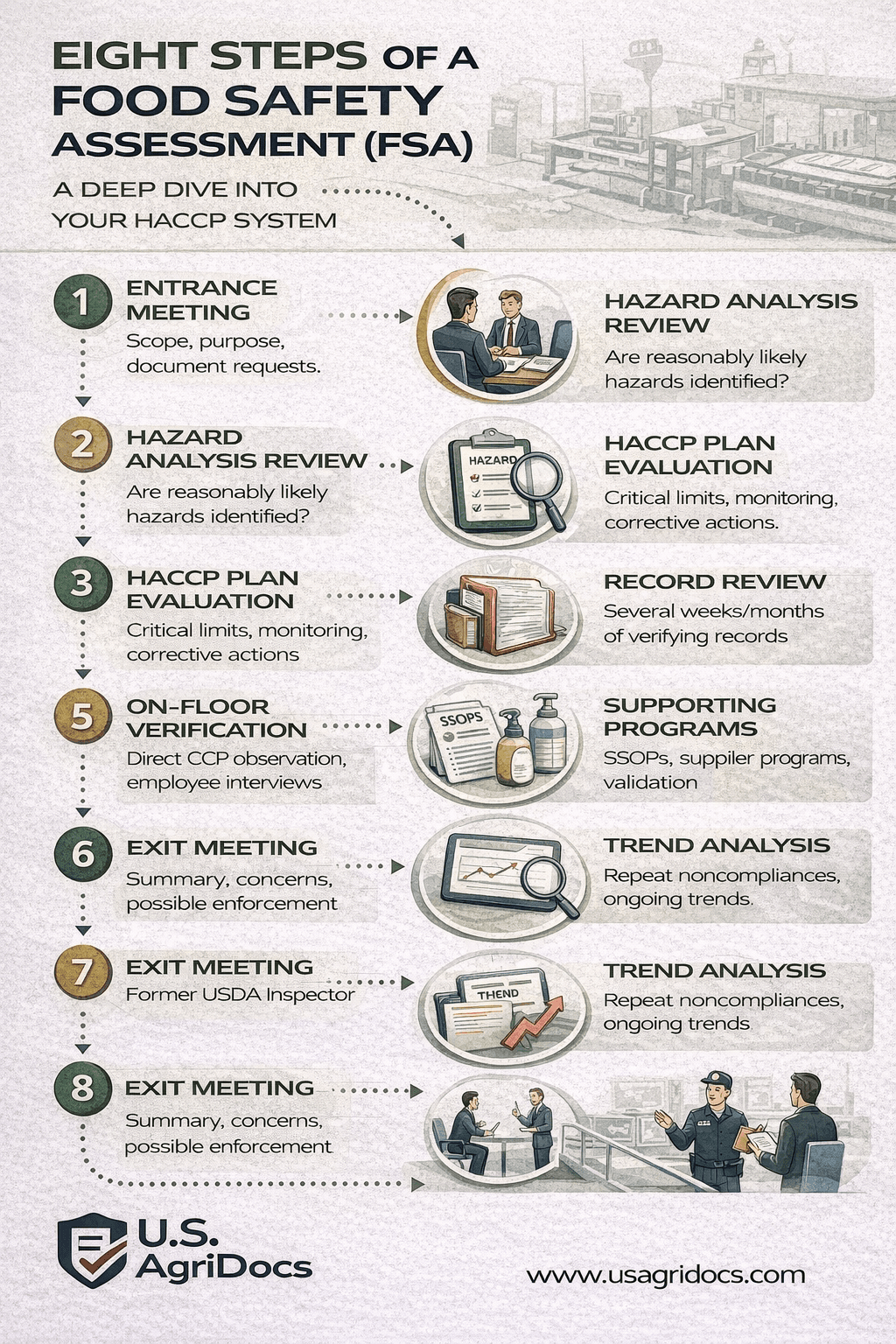
1. Entrance Meeting
The EIAO outlines the scope, explains document requests, and sets expectations for the assessment process.
2. Hazard Analysis Review
The EIAO evaluates whether all reasonably likely hazards are identified and supported with scientific documentation.
3. HACCP Plan Evaluation
Critical control points, monitoring procedures, corrective actions, and verification activities are reviewed for alignment with actual plant operations.
4. Record Review (Deep Dive)
Weeks or months of HACCP and verification records may be reviewed to identify missed monitoring, late entries, repeat deviations, and trend awareness.
Understanding FSIS Directive 5000.1 — Verifying Compliance with HACCP Systems
5. On-Floor Verification
The EIAO observes operations, employee practices, sanitation conditions, and product flow to ensure execution matches documentation.
6. Supporting Programs Review
SSOPs, sanitation records, supplier programs, recall plans, and validation documentation may be examined.
SSOPs Made Simple: Your Plant's First Line of Food Safety Defense
7. Trend Analysis
EIAOs assess repeat noncompliances, recurring corrective actions, and management oversight to determine overall system control.
8. Exit Meeting
Findings and concerns are summarized. Serious systemic issues may lead to enforcement actions, but strong systems pass successfully.
FSA Preparation Checklist
- Hazard analysis supported by scientific documentation
- HACCP plans reflect actual operations
- Verification activities documented on schedule
- No repeat deviations unaddressed
- Corrective actions prevent recurrence
- Records organized and accessible
How U.S. AgriDocs Reduces FSA Risk
U.S. AgriDocs centralizes HACCP and SSOP records, enforces verification workflows, surfaces trends, and provides audit-ready reporting.
Why Digital Recordkeeping Is Becoming the New Standard for FSIS Plants
The Bottom Line
An FSA evaluates whether your system works consistently. Plants that understand inspector expectations and maintain organized, trend-aware systems navigate FSAs smoothly.