
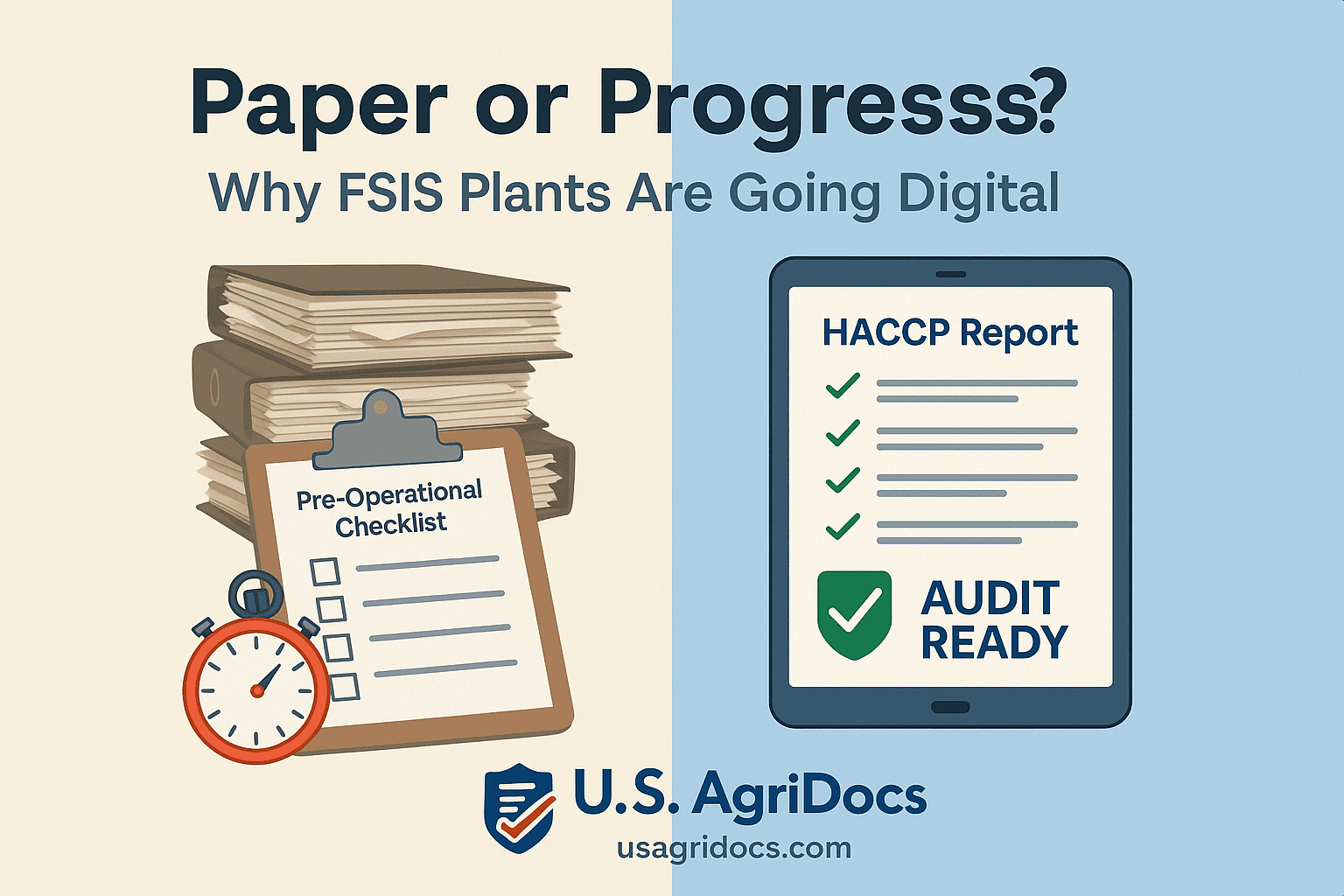
The Binder Era Is Ending
Every USDA plant knows that shelf — the one stacked with HACCP logs, sanitation checklists, calibration sheets, and pre-op verification forms. Binders are thick, stained, and occasionally held together with duct tape.
For decades, that was the compliance standard — stacks of paper standing between a plant and an NR.
But times have changed. The FSIS modernization movement, driven by both industry pressure and technological progress, has made one thing clear: Digital recordkeeping isn't a luxury anymore — it's the new baseline for compliance.
The Problem with Paper
Paper-based compliance once worked because plants were smaller, inspection processes were slower, and record volume was manageable. Today, that's no longer true.
A mid-sized USDA plant easily generates hundreds of HACCP and sanitation records every week. Multiply that by retention requirements under 9 CFR 417.5, and you're talking about tens of thousands of pages per year.
Beyond storage, paper comes with built-in risk:
- Records get misplaced, coffee-stained, or destroyed.
- Sign-offs happen late and aren't time-stamped.
- Auditors wait while staff dig through boxes or scan PDFs.
In the FSIS world, "If it's not documented, it didn't happen." And if your documentation system fails you, that can mean noncompliance — or worse, a suspended operation.
The Digital Shift
Over the past few years, FSIS has leaned heavily into data-driven oversight. From PHIS (Public Health Information System) to modernized inspection initiatives, the expectation is simple: Digital systems create traceability and accountability.
Plants that once hesitated to go digital are now realizing the benefits — not because someone told them to, but because it's becoming the way the system works.
- FSIS inspectors already document in PHIS.
- Establishments upload records for export verification.
- Remote audits and off-site reviews are now routine.
Paper can't keep up with that level of agility.
The Three Core Benefits of Digital Recordkeeping
1. Efficiency & Cost Savings
Most QA technicians spend 2–3 hours daily filling out, signing, and filing HACCP records. Digital recordkeeping cuts that by half.
If a QA lead earns $30/hour, saving two hours a day equals $15,600 per year — per employee. And that's before factoring in the cost of paper, toner, storage cabinets, and square footage dedicated to old binders.
With a system like U.S. AgriDocs, you don't need to buy more shelves. You just click "Save."
2. Audit Prep & Record Retrieval
Audit week used to mean stress, late nights, and caffeine. Now, plants using digital systems can pull years of data instantly — by date, product, or HACCP category.
When an inspector or third-party auditor asks for "last March's pre-shipment reviews," it's on-screen in seconds. No flipping through binders. No missing pages. No panic.
Pro Tip: Plants that prepare digitally for FSIS audits report faster closeouts and fewer document-based noncompliances.
3. Accuracy & Validation
Every FSIS compliance officer knows the frustration of "who signed this?" moments. Digital HACCP systems eliminate that problem.
- Every entry is timestamped and user-verified.
- Records can't be edited without a trace.
- Automatic alerts prevent missing signatures or incomplete logs.
In short, your documentation becomes audit-ready the moment it's created. And because everything is cloud-backed, it's also disaster-proof — no more floods or lost paper trails.
Case Study: The 60-Minute Audit
At one multi-shift poultry processor, inspectors requested 90 days of pre-op records for an EIAO review. With paper, that would have meant a full day of sorting. With U.S. AgriDocs, it took less than an hour to export, filter, and share — all verified and organized by date and product code.
The inspector's comment: "This is the cleanest record review I've ever seen."
Why This Is the New Standard
FSIS doesn't need to mandate "go paperless" for the industry to get the message. The speed of audits, the demand for traceability, and the shift toward remote oversight have already made paper obsolete.
Plants that stay paper-based will soon find themselves at a disadvantage:
- Slower to respond during audits.
- More prone to documentation errors.
- Less efficient in managing HACCP revisions and trending data.
Those that transition to digital? They'll spend more time improving food safety — and less time chasing signatures.
How U.S. AgriDocs Leads the Shift
U.S. AgriDocs was built by a former USDA inspector and a plant owner, designed specifically for FSIS-regulated operations.
With our platform, you can:
- Digitize HACCP, SSOP, and cooler logs instantly.
- Get AI-driven alerts for missing or incomplete entries.
- Auto-generate audit reports and verification summaries.
- Store all your data securely, accessible from any device.
When FSIS says, "Show me your records," you'll have them ready before they finish asking.
Bottom Line
The future of compliance isn't on paper — it's in the cloud.
Digital recordkeeping is no longer about convenience; it's about staying compliant, competitive, and audit-ready.
So the next time an inspector reaches for your binder, imagine handing them a tablet instead. That's not science fiction. That's U.S. AgriDocs.