
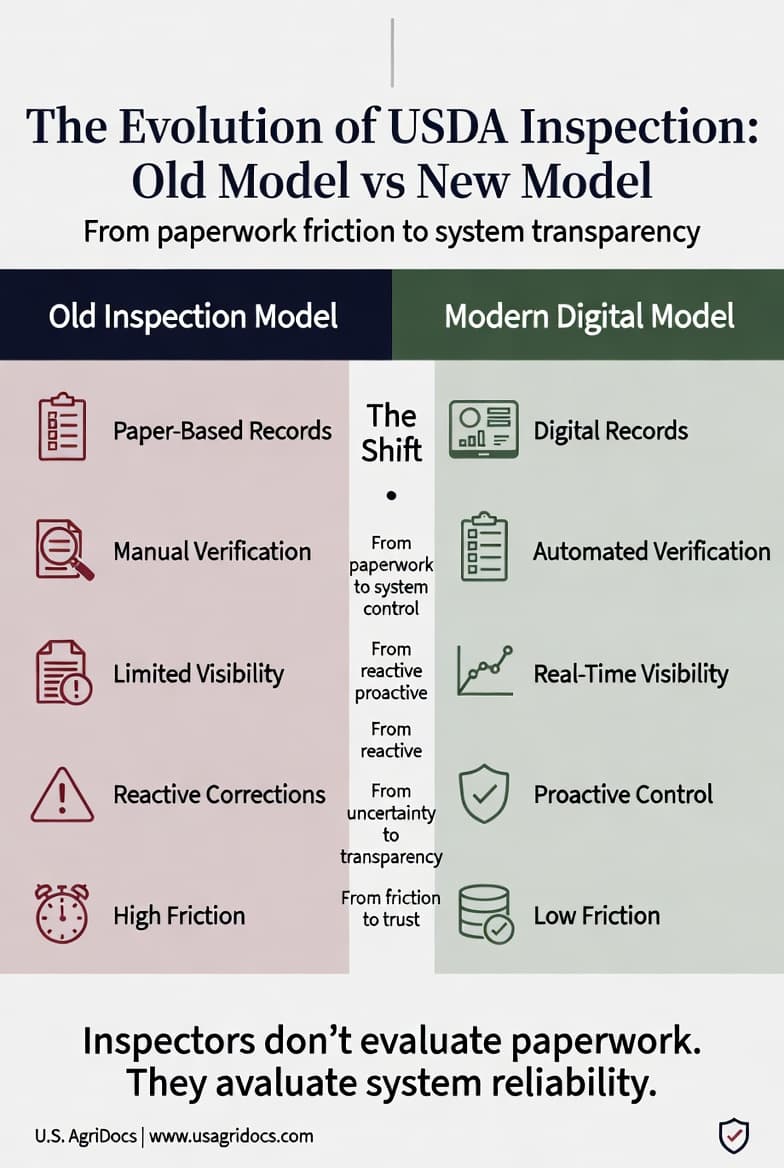
The Old Model: Paper, Pressure, and Friction
For decades, inspections relied on paper records, manual verification, and time-consuming document retrieval. This created unnecessary friction between inspectors and operators.
Inspectors had to request specific binders, wait for retrieval, and manually cross-reference records. Operators often felt blindsided by requests and scrambled to locate documentation. The result was a dynamic built more on pressure than partnership.
What Inspectors Actually Want
Inspector Priorities
- Consistency — Records completed the same way every time.
- Reliability — Data that can be trusted without second-guessing.
- Verification — Evidence that monitoring actually happened.
- System Control — Proof that the plant manages its own compliance over time.
Inspectors are not looking for perfection. They are looking for systems that work consistently and plants that demonstrate control over their own processes.
Where Technology Changes the Dynamic
Digital tools provide real-time records, enforce workflows, and eliminate ambiguity in documentation. Instead of pulling binders and flipping through pages, inspectors can review structured, timestamped records instantly.
This shifts the inspection from a retrieval exercise to a verification exercise — and that is better for everyone.
From ‘Show Me’ to ‘Let Me See’
The inspection dynamic shifts from requesting paperwork to evaluating structured systems. When records are digital, organized, and always accessible, the conversation changes.
Inspectors spend less time asking “where is this?” and more time evaluating whether the system is working. Operators spend less time scrambling and more time demonstrating competence.
Transparency Builds Trust
Complete, timestamped, and verified records reduce uncertainty and improve communication. When an inspector can see that monitoring was completed on time, corrective actions were documented, and verification steps were followed — trust builds naturally.
Transparency is not about exposing problems. It is about proving that your systems catch and correct them.
Trend Visibility
Digital systems allow identification of patterns such as repeat deviations and missed verification steps. This is valuable for both inspectors and operators.
What Trends Reveal
- Recurring temperature deviations on specific equipment
- Missed pre-op checks on certain days of the week
- Corrective actions that repeat without root cause resolution
- Verification gaps during shift changes
Benefits for Operators
- Visibility — See your compliance status in real time.
- Reduced Audit Stress — Records are always organized and accessible.
- Standardized Processes — Every shift follows the same workflow.
- Faster Response — Address issues before they escalate to NRs.
Benefits for Inspectors
- Faster Record Reviews — Structured data instead of handwritten logs.
- Increased Confidence — Timestamped, verified documentation.
- Pattern Recognition — Spot systemic issues across time periods.
- Less Friction — Spend time evaluating, not requesting.
How U.S. AgriDocs Supports This Shift
U.S. AgriDocs centralizes records, enforces verification workflows, and surfaces compliance trends — giving both inspectors and operators the tools they need to work together more effectively.
Key Platform Features
- Centralized digital recordkeeping with timestamped entries
- Automated task scheduling and completion tracking
- HACCP critical control monitoring with real-time alerts
- Inspector-accessible records without manual retrieval
- Compliance trend dashboards for proactive management