
What Is a Non-Compliance Record (NR)?
Every USDA-inspected establishment receives Non-Compliance Records (NRs) when an FSIS inspector observes a regulatory deviation. An NR isn't a fine — it's a formal notice that something in your process, sanitation, or documentation failed to meet a 9 CFR requirement.
Too many NRs — especially repetitive ones — can trigger an Enforcement Action Notification (EAN) or Notice of Intended Enforcement (NOIE). The goal isn't just to avoid NRs — it's to understand why they occur and build systems that prevent them.
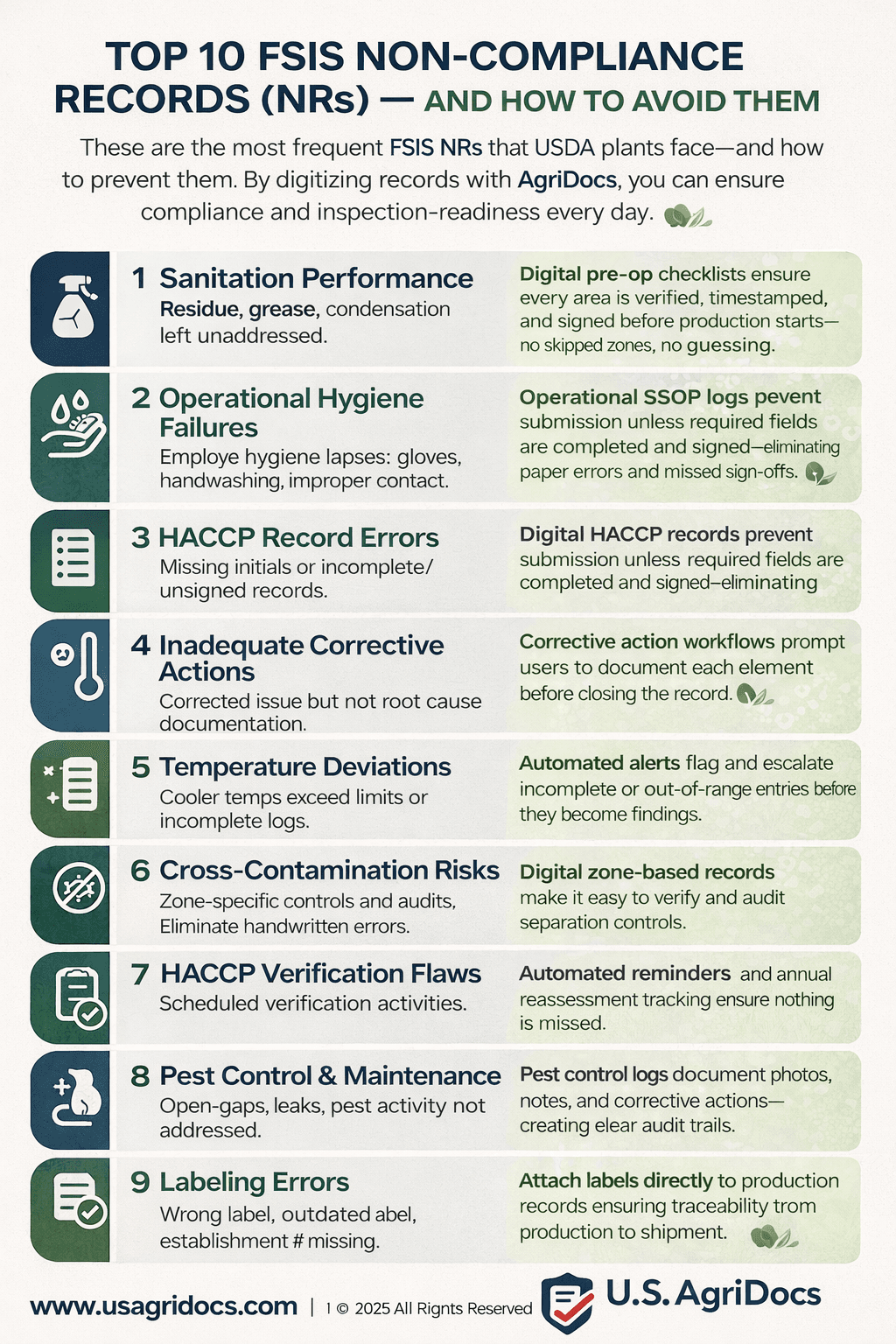
The Top 10 Most Common NRs
1. Sanitation Performance Standards (9 CFR 416.4)
Why It Happens: Residue, condensation, or equipment not visibly clean before production.
Avoid It: Train sanitation crews on pre-op visual standards and verify each zone with timestamped checks.
AgriDocs Advantage: Digital pre-op checklists log who verified what — and when — eliminating missed zones.
2. Operational Sanitation (9 CFR 416.5)
Why It Happens: Employees fail to follow hygiene practices (handwashing, gloves, product contact).
Avoid It: Supervisors should conduct random hygiene observations and document them daily.
AgriDocs Advantage: Daily SSOP verification logs make trend tracking simple — helping identify repeat offenders early.
3. HACCP Recordkeeping (9 CFR 417.5)
Why It Happens: Missing initials, unsigned pre-shipment reviews, or incomplete CCP logs.
Avoid It: Review records immediately after each shift — not weekly.
AgriDocs Advantage: Automatic timestamping and digital signatures ensure every record is signed on time.
4. Corrective Actions (9 CFR 417.3)
Why It Happens: Plants record "corrective action taken" but fail to describe the root cause or preventive step.
Avoid It: Require both immediate and preventive sections for every corrective action.
AgriDocs Advantage: Built-in prompts force complete entries before a record can be submitted.
5. Temperature Control Failures
Why It Happens: Cooler logs missing data, thermometer calibration lapses, or exceeding critical limits.
Avoid It: Implement automatic alerts when readings exceed thresholds or logs are incomplete.
AgriDocs Advantage: AI alerts flag missing or out-of-range readings before an inspector does.
6. Product Handling and Cross-Contamination
Why It Happens: Raw and ready-to-eat areas overlap, or utensils aren't properly segregated.
Avoid It: Color-coded tools and zone-based monitoring.
AgriDocs Advantage: Digital maps and zone identifiers make it easy to assign and verify separation protocols.
7. Verification and Validation (9 CFR 417.4)
Why It Happens: Annual reassessment or ongoing verification not documented.
Avoid It: Schedule digital reminders for annual validations.
AgriDocs Advantage: Auto-reminder feature ensures validation dates are never missed.
8. Pest Control and Facility Maintenance
Why It Happens: Gaps, leaks, or pest sightings not documented or corrected promptly.
Avoid It: Weekly facility inspections and documented corrective action logs.
AgriDocs Advantage: Image upload feature allows QA to attach photos of repairs directly to records.
9. Labeling and Product ID
Why It Happens: Product labeling errors, outdated labels, or missing establishment numbers.
Avoid It: Maintain a digital label library and verify label approval numbers.
AgriDocs Advantage: Attach labels to production lots in-app — creating a traceable record for every SKU.
10. Documentation Integrity
Why It Happens: Pencil edits, white-outs, or backdated signatures.
Avoid It: Reinforce that falsifying records is a regulatory violation and a legal risk.
AgriDocs Advantage: Immutable digital logs create a tamper-proof audit trail that protects the establishment.
Turning NRs Into Opportunities
Noncompliances aren't the enemy — they're data points. Plants that treat NRs as feedback loops tend to have the lowest repeat rates.
With U.S. AgriDocs, you can trend NR types, identify problem areas, and take corrective actions before FSIS does. It's not just digital recordkeeping — it's proactive compliance.